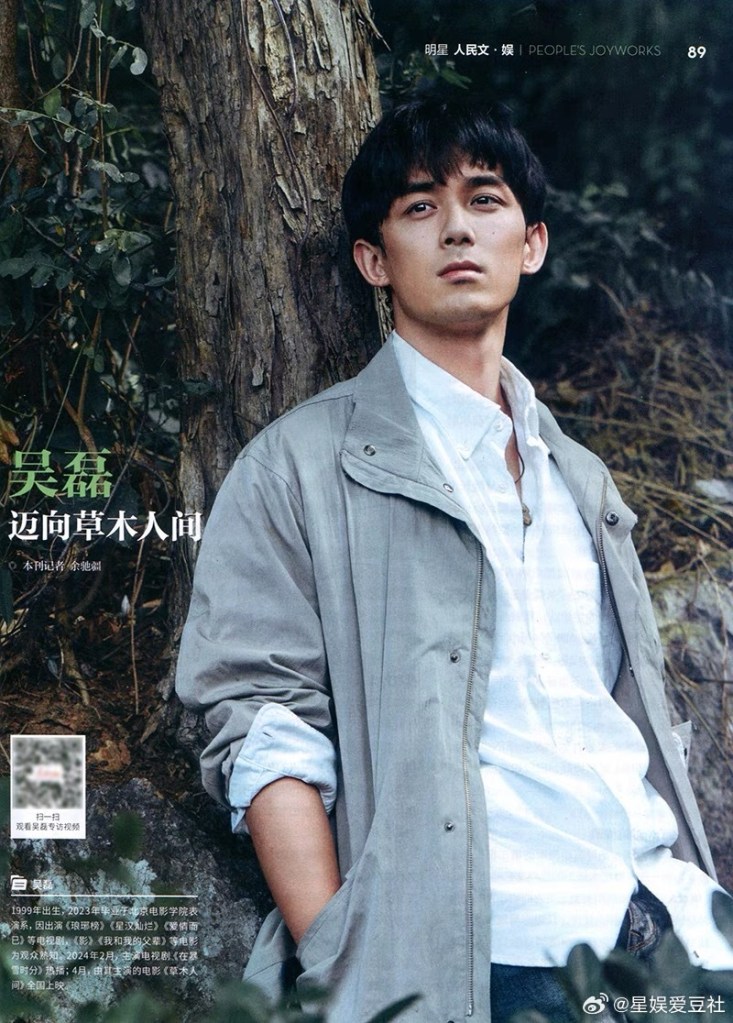
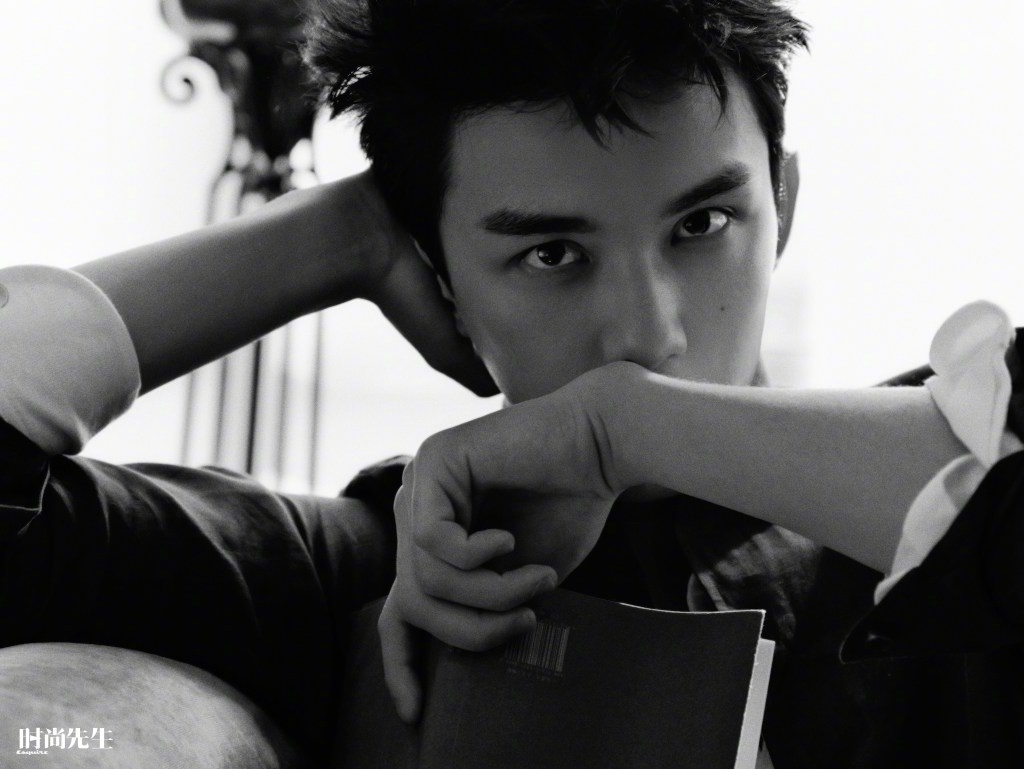
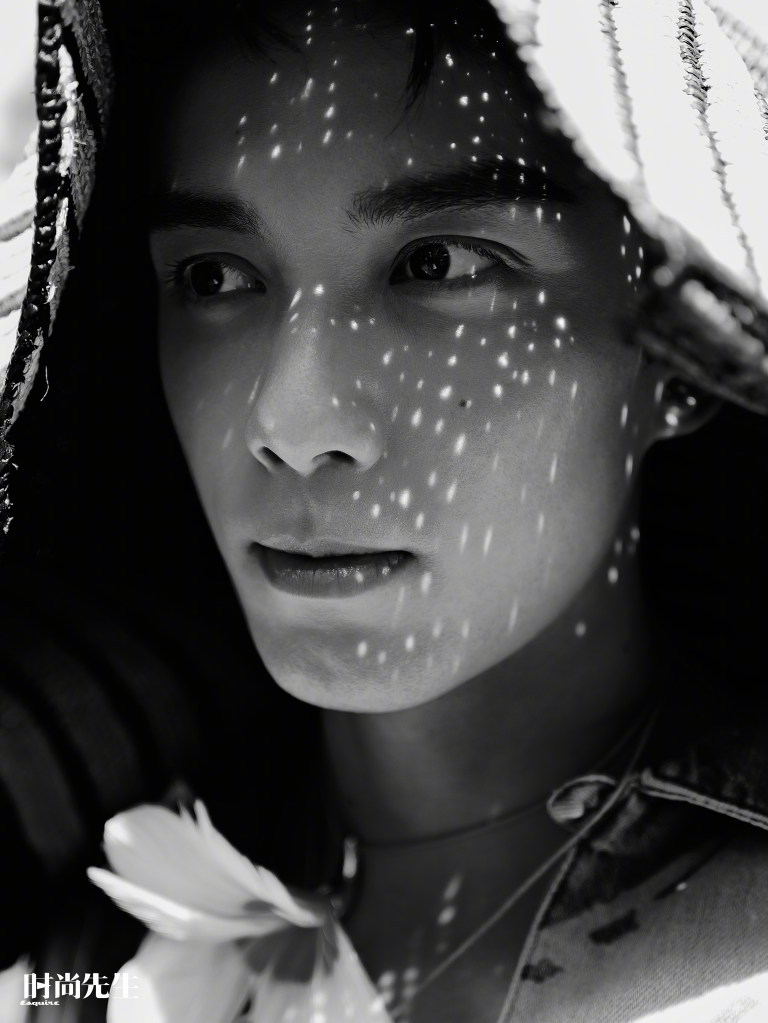
[Interview] Wu Lei Exclusive Interview with People’s JoyWorks (Global People Magazine April 2024)

Wu Lei, heading towards “Dwelling By The West Lake

Reporter Yu Chixie
Editor Zhang Mian

Wu Lei
Born in 1999, graduated from the Performance Department of Beijing Film Academy in 2023. He is well-known to the audience for his roles in TV series such as “Nirvana in Fire”, “Love Like The Galaxy”, “Nothing But You”, and movies such as “Shadows” and “My Country, My Parents”. In February 2024, the TV series “Amidst a Snowstorm of Love” starring him was popular; in April 2024, the movie “Dwelling By The West Lake” starring him was released nationwide.


If we count from the first time he acted in a TV series at the age of 5, Wu Lei has been in the industry for almost 20 years. If we count from the first time he filmed an advertisement, we have to add “2” to this number. In short, he is young but has a long artistic career.

As a result of gaining fame in childhood, Wu Lei seems to have implemented a “dual-track system” in the hearts of the audience. One track is his on-screen image. The audience witnessed him playing roles from little Nezha to little Yang Guo, from a teenage guardian to a handsome general. Last year, he portrayed Song Sanchuan who has “older woman – younger man relationship” in “Nothing But You”. This year, he become the rebellious senior brother Lin Yiyang in “Amidst a Snowstorm of Love”.

The other track is Wu Lei’s personal image in life. The “national younger brother” who has been the same for a decade has suddenly grown up: the baby fat faded away, his figure became taller and stronger, his eyes became deeper, and his conversation became more steady. In the words of his “fans”, the child has suddenly transformed to a “hormone player”.

For child stars, both tracks have bottlenecks. In terms of acting, many people cannot escape the fate of “Injuring Zhongyong”*. As they grow older, their aura gradually fades, eventually leaving behind the regret of “peaking at debut”. In personal life, there are also many people who have lost their way in The Truman World* and unable to break free from the beautiful fantasy woven in their childhood.

*”Injuring Zhongyong” is a story about Fang Zhongyong, a child prodigy that born very talented but eventually become ordinary person because he didn’t study. The story warns people that they must never rely solely on talent without learning new knowledge and must pay attention to acquired education and learning

*The Truman World is the world in the movie The Truman Show (1998)

Fortunately, Wu Lei is clear-headed and solid in both aspects. He told the reporter of “Global People”: “From being ignorant to having initial understanding of the profession, and now graduating from university, I have been moving forward step by step, and gradually realized the weight of the word ‘actor'”. On the day of the interview, Wu Lei was on the road show for movie “Dwelling By The West Lake”. He worked non-stop despite having a heavy cold and kept carrying hot water with him, but as soon as the camera was turned on, he immediately regained the spirit and energy he required for promotions and showing no sign of fatigue.

The signature smile is still there, the familiar youthful feeling is still there, but no one would doubt that child star Wu Lei has transformed into young actor Wu Lei.

Son of Nature, Fighting Against Pyramid Schemes

“Dwelling by the West Lake” is the second feature film directed by Gu Xiaogang. Slightly different from the first film, “Dwelling in the Fuchun Mountains”, which is pure artistic, “Dwelling by the West Lake” is more distinctive in plot and genre, especially its in-depth exploration of the theme of “anti-pyramid schemes”, which makes the film present a strong social attribute. In the film, He Mulian (played by Wu Lei) and her mother, Wu Taihua (played by Jiang Qinqin) depend on each other. When his mother falls victim to a pyramid scheme, Mulian embarks on a modern story of “Mulian Rescues His Mother”.

When he first received the script, Wu Lei was a little frightened. “I really liked Director Gu’s ‘Dwelling in the Fuchun Mountains.’ When I first received the script for ‘Dwelling by the West Lake’ I was a bit hesitant to take it because I like the story and the characters so much. But later, thanks to the director and my family’s encouragement, I was able to take this role.”

In the film, the keyword of Mulian’s life is ‘searching’: at the beginning, he searches for his father who had been away from home for many years without any news; then, he searches for his mother who has been consumed by a pyramid scheme and became obsessed; finally, he searches for his true self within when he was scarred.

Outside the film, Wu Lei used “some silly methods” to find Mulian. “He is a child from the countryside, simple and kind, quiet and taciturn, like a lotus flower that emerges from the mud unstained, and like a strong and upright tree. No matter what happens, he will always grows towards the direction of light.”

Wu Lei used four words to describe the character: the son of nature. Therefore, in addition to reading the script carefully, he began to raise plants, visited botanical gardens and forests in the mountains, “trying to establish some connections with nature.” The initial scenes of the film were shot with Mulian walking in the forest. The director asked Wu Lei to “have a dialogue” with the trees, “talk with the strong trees, as well as the broken ones, to live and breathe in the space of the entire forest, and resonate with the trees.”

This kind of interaction would be uninteresting if it’s too little, and unnatural if it’s too much. It wasn’t until Wu Lei was lying on the grass, with the sun hitting his face through the Tyndall effect, and the ants crawling up his collarbones and cheeks, that he closed his eyes and fully surrendered his heart to nature. Only then he felt that he had successfully transitioned into becoming Mulian.

Literary and artistic scenes rely on feelings, while realistic portrayal is the true test of one’s body and mind. In the film, Mulian experiences multiple emotional transitions: the determination to leave after accidentally getting involved with elderly fraud gang “sales meeting” while looking for a job, the confusion and anxiety when he discovered his mother sold the house to buy MLM products, the powerlessness and collapse when trying to awaken his mother in the rain, and the forbearance and ourburst when he finally made a desperate move to infiltrate the pyramid scheme group to collect evidence.

Before filming each pyramid scheme scenes, Wu Lei and Jiang Qinqin looked at each other in silence while waiting, “Because the director gave us a lot of room for performance, we didn’t know what kind of scenes we would face next. Each time was a brand new thrilling experience.”

In the film, a large number of pyramid scheme scenes were created by director Gu Xiaogang after he personally “went undercover” in a pyramid scheme organization: group induction on the bus, spiritual speech on stage, emotional manipulation in a small dark room. Each scene is an extreme “brainwashing scene”. This experience also made Wu Lei feel the horror of pyramid schemes, said “the filming was heartbreaking and made your head spins”.

One much-discussed scene take place under the bridge on a rainy night, Wu Taihua kicked and beat her son, blaming him for ruining her “dream of getting rich”, while shouting obsessively: “I am willing to be deceived, I’m happy, I’m happy!” Jiang Qinqin goes wild with her makeup, and Wu Lei cried and screams in tears. Even after the director called a stop, the “mother and son” couldn’t immediately get out of character, and Wu Lei cried for a long time in the car.

“After filming this story, I have gained a greater understanding of the persecution and impact pyramid schemes inflict on the person and the family.” Wu Lei told reporters, “We must raise awareness of anti-pyramid schemes. We should give more care and love to our elderly family members at home. If our family members encounter pyramid schemes, we should patiently dissuade them and seek police assistance.”

Always Have the Courage and Determination of a Child

“Crying scenes are intense emotional scenes, and I usually nervous and have anticipation for scenes with intence emotions, such as extreme pain, extreme crying, extreme happiness or anger.” Speaking of that heart-wrenching crying scene in the rain, Wu Lei said: “I think you shouldn’t have a comfort zone in acting. You should take every emotion as your own nervous zone. You shouldn’t underestimate any scene.”

In Wu Lei’s view, this nervousness is not only a respect for acting, but also a vigilance against empiricism. When he was a kid, acting meant “being taken to the scene to start acting”; after becoming famous, acting became a hobby and a daily routine; after being admitted to the Film Academy, he had to face the retraining of mentality and methods.

On his 18th birthday, Wu Lei received a letter from his mother at the birthday party. He cried while reading it: “In the past 13 years of filming, your mother has seen all the ups and downs in your life. You had a high fever but insisted on finishing the filming before going to the hospital. When you were getting an injection, you turned your head away and cried silently. You made your mother so proud and distressed.” When the clock struck 12, Wu Lei suddenly thought: It would be great if I could always be 18 years old. “I hope I can always have the courage and determination I had as a child.”

When he was 3 years old, Wu Lei was discovered by a scout and filmed his first advertisement. As a result, he became unstoppable and received more than 50 advertising invitations in just two years. When he was 5 years old, the TV series “The Legend and the Hero” came to the school for casting. He volunteered to act in a segment and made his debut successfully. Over the next decade, he was a popular little brother on the screen. The audience could see him in various works every year, including modern dramas, costume dramas, comedies, dramas, and fantasy dramas.

“Nirvana in Fire” in 2015 was Wu Lei’s first milestone. In this phenomenal drama, Wu Lei perfectly portrayed the coldness and warmth of a teenage guardian, and his performance was remarkable among the acting talents. In 2017, he joined the movie “Shadows” directed by Zhang Yimou and got a rare opportunity to hone his skills.

The seemingly smooth road to fame actually also involved inner struggles. In 2018, Wu Lei was admitted to the Beijing Film Academy as the first place in his major. His deepest feeling after entering the school was “inferiority” and “lacking”. Many of his classmates have been learning professional acting since high school, but he is more like a student who has been trained on the set, and there is still a gap between him and the academic method. “Maybe I have more serious film and television filming experience, but actually I still need a lot of practice.”

So, he slowed down the pace of his work and spent more time on self-improvement. When he was in school, he got up at 5:30 to practice morning exercises to make up for the missing knowledge; on the set, he was no longer just a “tool man” who does what he is told, but learned to explore and think on his own. To played a boy in a wheelchair in the e-sports drama “Cross Fire”, he studied a lot of e-sports player documentaries and the daily movements of people with disabilities. To played a blind student in the movie “Adoring”, he would stay in the dark for a while every day to get the feel for it and he didn’t even turn on the light when taking a shower.

This habit to do preparation has continued to this day, and has even developed to the point where he can master a skill every time he shoots a drama. When shooting “The Long Ballad”, Wu Lei did 4 months of high-intensity training, and put the original comics on the bathroom mirror every day to remind himself how to look like the original comics: In “Nothing But You”, he practiced tennis and badminton alternately, and even professional coaches praised him after 3 months of training; in “Amidst a Snowstorm of Love”, he practiced snooker to the point that Ding Junhui reposted his Weibo and made an appointment to play a game with him……

“Sometimes I see seniors receiving awards at some events, and listen to their speeches, I really admire their humility and passion, and I feel that I haven’t done enough.” Wu Lei said, “Although I have indeed worked for some years, I still feel that I’m just getting started.”

In his opinion, there is no shortcut to acting, only “sincerity can move mpuntains and open up new horizons.”

An Old Actor’s Soul

Host He Jiong once commented on Wu Lei: “He work like a man, live like a teenager.” This youthfulness can be seen from Wu Lei’s cycling documentary. In the past 2 years, his cycling vlog filmed by himself went viral on the Internet, allowing the public to see the down-to-earth side of the young actor. In those daily records, Wu Lei does not shy away from the “gray tone” in life: everyone has anxiety and times when they don’t want to talk. In the entertainment industry, high pressure and fast pace often make people lose the true nature of life.

One of the ways Wu Lei relieves his anxiety is by cycling. He rode 90 kilometers alone from Quanzhou to Xiamen, watching the sunset, taking pictures of the sunset, talking to strangers, and taking pictures with the geese that crossed the highway. On his 22nd birthday, he gave himself a gift of a trip to Ulan Butong, Inner Mongolia, where he galloped on the snowy plains at minus 30 degrees Celsius, setting up tents for camping, running to the top of the mountain with a flashlight in his hand, and taking pictures of the vast starry sky.

Last year, Wu Lei’s went to Xinjiang. He rode his bike through the mountains and grasslands of northern Xinjiang and experienced unknown scenery around Sailimu Lake. He has seen the clear skies with the lake and sky blending in the same color, and also encountered sudden heavy rain and hail. “I feel that Sailimu Lake is very good to me. I have encountered all kinds of weather. This trip is worthwhile! The tiny me has conquered a big lake, riding my small bicycle.”

He said: “Perhaps the meaning of the journey is found on the road. Sometimes you don’t need a reason to start and try.”

“If you give yourself a long vacation, how long do you want it to be? How would you arrange it?” the reporter asked. “One and a half months for travelling, one and a half months of doing nothing and idling time away, and the remaining three months at home reflecting about life and talking to myself.” This answer is unexpected, but also reasonable.

During the process of working with Wu Lei on “Dwelling by the West Lake”, actor Chen Jianbin was often confused: “He is only 23 years old, why does he have the soul of an old actor? Although he has been in the industry for a long time, he has not been tainted by Jianghu* spirit, and his heart is still pure.”

*Jianghu usually refers to the martial arts world of ancient China. But in modern sense, this word use to describe anarchic societies like gangster and organized crime where people were acting unlawful, wild, rude, etc.

For Wu Lei, who grew up under the spotlight, this sincerity is precious. He works hard and lives hard; he puts himself in front of the camera but keeps himself away from the hustle and bustle. As he often said: “Self is freedom and me.” Perhaps, it is this freedom and true self that allows Wu Lei to move from The Truman Show to the sunny world of “Dwelling by the West Lake”.

Scanned interview from Star Entertainment Idol Club. Original article on weibo.

231225 [Interview] Wu Lei: Breaking The Wind | GRAZIA Magazine December 2023

WULEI
Breaking Wind

*Breaking Wind is a term used in cycling to describe a rider who is able to break away from the main group and ride alone at a faster speed

In the past few years of falling in love with cycling, Wu Lei often finds himself in moments where he needs to “compete” with the wind.

In professional road cycling, this is called “breaking wind.” The whistling sound passing by the ears is not a clear proof of speed but also the greatest resistance to go forward. Therefore, all tactics at this moment revolve around the wind. The unseen wind becomes a perceived opponent. Wu Lei understands that he needs to surpass not only the wind but also his own self from the previous second.


The moment writing this, Beijing has just experienced its first heavy snowfall of the winter. In the photo of Wu Lei playing in the snow that he posted on Weibo, he is joyfully playing in the snow with his beloved dog Xiao Bei, diving headfirst into the thick snowdrift. A clean face without any makeup, slightly reddened by the cold wind. Covered with snow, combined with the untrimmed blue-green stubble on his chin, his big smile at this moment strikes directly at the heart.

These moments brimming with the freshness of life often appear on Wu Lei’s social media platforms. They are mostly candid shots that don’t overly focus on composition: such as the disheveled encounter with heavy rain after watching a movie late at night, or a stroll through a hutong one evening. Wu Lei doesn’t shy away from these less “refined” and even somewhat rough moments. While recording a cycling vlog in Xinjiang, despite having four pimples on his cheek due to staying up late, he boldly faces the camera and starts recording the video.

In the first half of this year, on the second day after the completion of the filming of the new drama “Amidst A Snowstorm of Love” Wu Lei embarked on a cycling journey in Northern Xinjiang. This also marks the second season of his personal cycling video series “Ride Now.” Despite more than half a year passing, Wu Lei still holds vivid memories of Northern Xinjiang. Mentioning the first day of the journey, the circumnavigation of Sailimu Lake, he felt it was an experience that he would “never forget in this lifetime.”

Sailimu Lake, situated at an altitude of over 2000 meters, has a cycling loop of 90 kilometers and Wu Lei took two days to complete it. On the first day of circumnavigating the lake, he coincidentally encountered rare May weather at Sailimu Lake, characterized by wind, rain and hail. Wu Lei described riding in the rain as an “exhausting but exciting” experience: his body felt the cold from the rain and the soreness after exhaustion, yet internally he had already scripted a passionate and dramatic narrative, urging him to persist and complete this solo lake circumnavigation.

Most of the time, cycling is a solitary activity, without interactive companions or competitors; the only challenge is the vast mountains and seas ahead. In Northern Xinjiang, Wu Lei found numerous moments that were exclusively his own. He talked about camping by Sailimu Lake, spending the night in an “isolated from the world” manner: “It feels like being in a corner of the Earth in the universe, a corner that belongs only to me and everything outside has nothing to do with me.”

Even six months later today, Wu Lei has not obtained an answer regarding the meaning of this journey. However at this moment, he no longer needs an answer: “I feel that many times we are trying to attribute meaning to something, as if always giving ourselves a psychological suggestion, as if to prove, ‘I’ve come, my journey must be fruitful.’ Upon careful consideration, it’s actually quite unnecessary. You can just enjoy the process without any purpose or summarization, without dividing your life into segments. In Wu Lei’s view, when it comes to cycling, it’s best to “not think about anything” clear the mind and focus solely on the act of “riding”. Just enjoy being in it.

What also engrosses him is acting. The new movie “All Ears” is scheduled to be released in September this year. Wu Lei plays a character named Xiaoyin, who is somewhat special: not only is he a character created by the male lead, Wenshan (played by Hu Ge) but he is also a reflection of Wenshan and even another personality of Wenshan, representing his inner self. Wu Lei believes that this character is more like “the other self that everyone talks to in their hearts.” He uses himself as a reference: when a person is in a certain state, when do they need to have a dialogue with themselves, and how to deal with the appearance of different voices in their hearts. Wu Lei often engages in this kind of “dialogue with himself.” He gradually realized that “self-reconciliation” might be a lifelong theme for humans especially for actors, pondering and understanding the “true self” is particularly important.

Only when interacting with a character does he strive to become “someone else.” In the upcoming drama “Amidst A Snowstorm of Love” Wu Lei plays Lin Yiyang, a professional snooker player. Before the start of filming, he watched documentaries about professional athletes, studying their playing habits: “Including the actions that occur after scoring or winning or losing, everything will be referenced when getting into the character. After all, I haven’t played in a competition myself.” He also played a professional tennis player in “Nothing But You”. The playing style of Song Sanchuan was largely modeled after Nadal.

At the age of 5, Wu Lei entered the entertainment industry and now approaching 24, he has nearly 19 years of acting experience. However on set, he still occasionally feels “nervous.” Last year, during the filming of “All Ears” he recalls it as a few months where he felt “like returning to being a student.” With director Cao Baoping who also served as the producer, present on set, there was always something new to learn every day. He had to summon the determination for a major exam, maintaining a high level of focus at all times.

The two upcoming films, along with director Xu Haofeng’s new-style martial arts film “Decent Things” and the already premiered “Dwelling By The West Lake” provide a diverse range of roles for Wu Lei. “Dwelling By The West Lake” draws inspiration from the legend of “Mulian saves his mother” portraying a modern version of the story where the son, Mulian, tries to rescue his mother, Taihua, from a fraudulent organization, only to find themselves both in more desperate circumstances. Wu Lei described the creative process of this film as a “quite painful” experience, not due to the lack of joy in the creation itself but because the demands of the characters and the story took a toll on both his mind and body.

Wu Lei has previously watched director Gu Xiaogang’s work, particularly “Dwelling In the Fuchun Mountains” which won Best Feature Film and Best Director at the 13th FIRST Youth Film Festival. This movie tells the daily life of three generations living by the Fuchun River in Hangzhou and is predominantly performed by non-professional actors. Wu Lei expressed that after watching this film, he was “shocked.” The extreme authenticity from non-professional actors even led him to question his own performance: “Such performances are truly touching.”

Wu Lei took a considerable amount of time to contemplate before deciding to take on the script of “草木人间” (“Dwelling By The West Lake”). With the seriousness characteristic of a Capricorn, he operates in only two states: “not doing” or “doing it the best.” There is no middle ground of indecision. According to director Gu Xiaogang, before the movie started filming, Wu Lei had already immersed himself in the character’s state: he cultivated plants, started paying attention to time and nature. By the time the plants he nurtured blossomed, meeting Wu Lei on set at the beginning of filming was akin to encountering the character of Mulian in the story.

On the other hand, shooting “入型入格” (Decent Things) provided a different, exhilarating experience.

Director Xu Haofeng’s works always exhibit a distinctive “Xu style aesthetics.” The intense fight scenes, rich in rustic martial arts flavor, exude a straightforward and unadorned Jianghu atmosphere. The title “人型人格” (Decent Things) refers to the Cantonese phrase for “doing things beautifully.” Actor Chen Kun, reflecting on the numerous action scenes, expressed that they filmed fight scenes continuously for over twenty days. Wu Lei found the experience quite “extraordinary,” saying, “The first feeling is that it’s very cool, as if I’ve truly become that ‘Southern hermit’ seeking justice. Every day, I’m doing cool things, constantly ‘being formatted.'”

The presence of distinct differences between characters is not a deliberate pursuit or effort on Wu Lei’s part. He doesn’t resist the appearance of similar roles and acknowledges that delivering a different interpretation within the same type of character requires significant effort.

Wu Lei doesn’t believe there is an absolute “comfort zone” in acting. He views characters as living individuals and acknowledges that no role is entirely “comfortable” because he and the character are distinct entities. While he may feel the excitement of a fresh challenge, he doesn’t pursue it as the sole purpose of his endeavors.

Wu Lei continues to face challenges in determining the types of roles and projects he should pursue. However, he has shifted his perspective, realizing that blindly challenging himself might not be a cause for celebration. He now believes that actors should focus on getting closer to the characters rather than insisting on specific roles or scripts. He acknowledges that encountering roles is often a matter of fate, and he embraces the exploration and possibilities within his passionate profession. With a readiness to explore, this 24 year old actor is prepared to break through barriers and move forward.


Feel Wu Lei’s ‘down-to-earth flight.’

G: After returning from Xinjiang, have you gone cycling again? Where did you ride to?

W: Yes, I’ve cycled in Beijing occasionally after work. There’s no specific destination, most of the time, I just ride for as long as I feel like it. I might have an initial expectation in mind, but it often changes during the ride.

G: What’s the longest ride you’ve had, and how many kilometers did you cover?

W: Probably around 100 km. If I feel good and not tired, I might extend the ride, but if I’m tired, I’ll head back.

G: Among all your cycling experiences, which one is the most memorable, an experience you’ll never forget?

W: It should be the first time I hit the road with a mountain bike. It was the first experience of that speed and the feeling of flying close to the ground. I was amazed at how enjoyable and stress-relieving cycling could be.

G: Filming in Finland, what’s the most memorable experience for you?

W: After filming, I saw the beautiful Northern Lights. Also, there were some small moments during the shoot. The local co-production team was very professional and many scenes, like taking the tram and other public transportation, were filmed without disrupting the local public services. It made me feel like I easily blended into the local life. Even though I didn’t actually live there, during those several tens of days, it felt like I experienced the life of the locals.

G: “All Ears” discusses a lot about the theme of “reconciling with oneself.” Have you had such an experience yourself?

W: I think I often have internal dialogues with myself. Occasionally, I figure out many things, and then there’s a resolution. Actually, I think it’s quite important; many things are just a result of trapping oneself.

G: “Dwelling By The West Lake” went to the Tokyo International Film Festival. How did you feel receiving feedback from the audience?

W: I felt very good and beautiful, but in reality, a bit nervous because you never know if the audience will like it or not. However after the premiere, the audience’s feedback was quite positive and it felt satisfying. When dubbing, I actually watched the completed film once. This time, during the premiere, we watched it again on the big screen with the audience and it brought a different feeling.

G: Share a recent moment that you found particularly beautiful.

W: Just this morning, when I was on my way to work, there happened to be a traffic light and at that moment, the clouds in the sky looked beautiful. Some clouds were high, some were low and behind the low clouds, there were many high clouds. They stacked together, creating a beautiful scene.

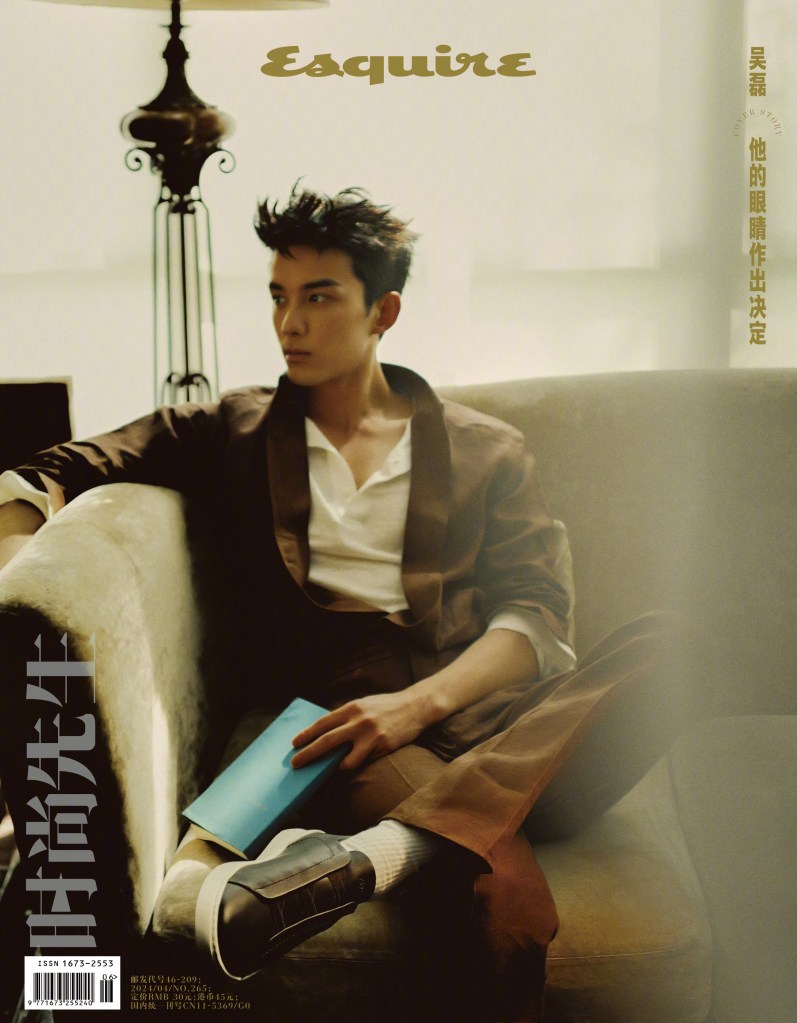
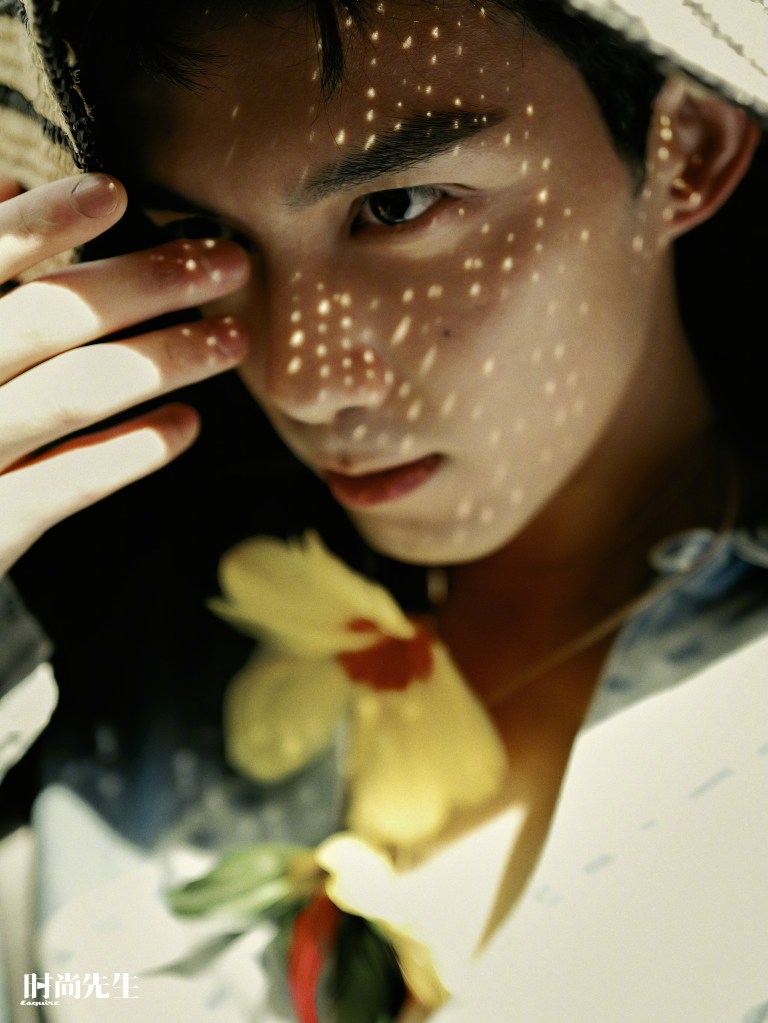
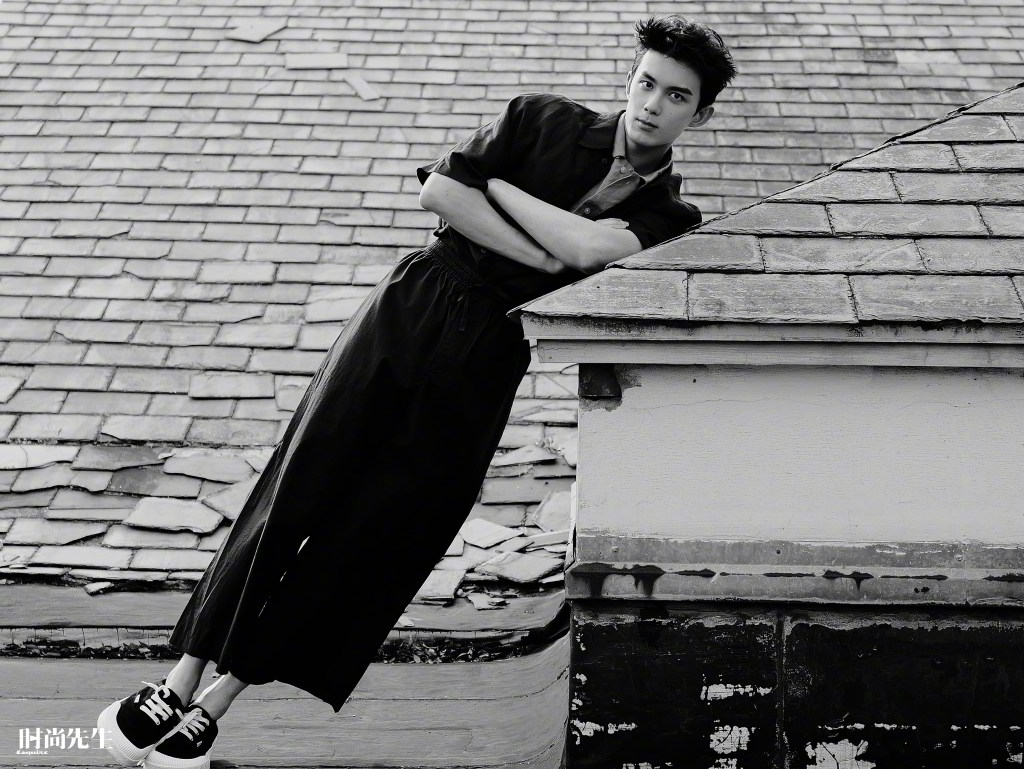
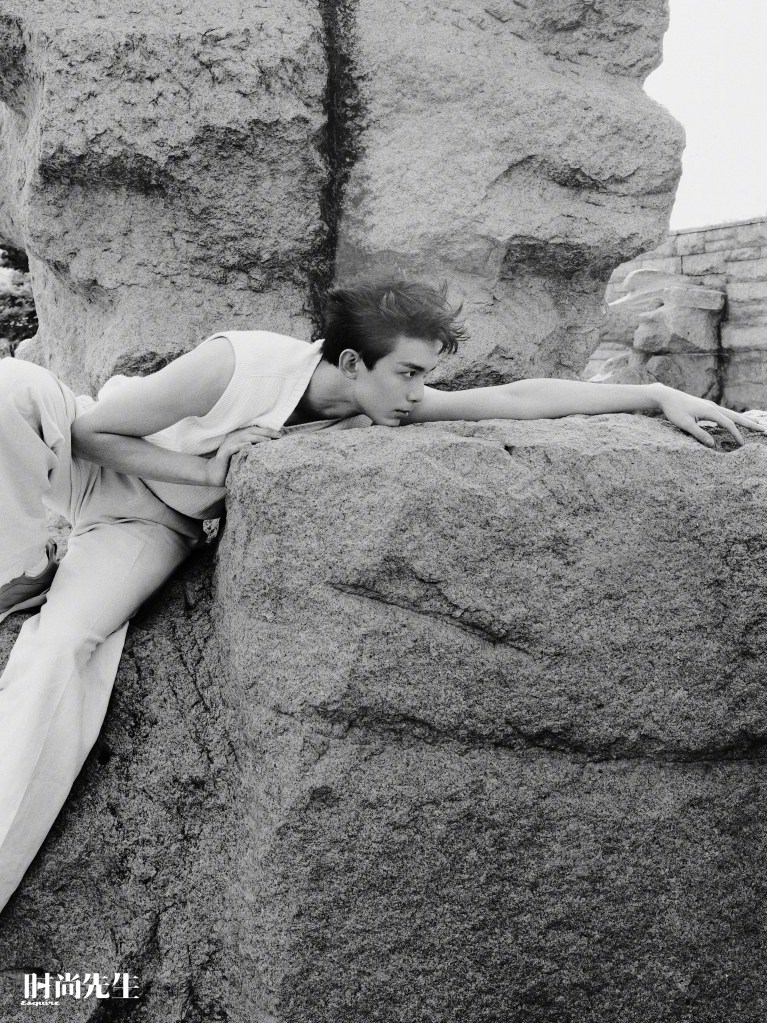
240414 [Interview] Wu Lei: His eyes make decisions | Esquire Magazine April 2024

One notices, if one will trust one’s eyes,
The shadow cast by language upon truth:

The bright and brutal surfaces of things
Awaited the decision of his eyes,

W. H. Auden, “Kairos and Logos”

Before receiving the script for «Dwelling by the West Lake», Wu Lei had already seen Director Gu Xiaogang’s first movie «Dwelling in the Fuchun Mountains». That movie first won the Best Picture Award at the 2019 FIRST International Film Festival, and later was selected as one of the top ten films of the 2020 French «Cahiers du Cinéma», obtaining recognition from numerous authoritative awards. The flowing Shanshui paintings, the rich urban atmosphere, the natural amateur actors… Wu Lei has a deep memory of this last point. He remembers watching «Dwelling in the Fuchun Mountains» in an afternoon, thinking about acting for a long time.

In 2022, when he received the script with the director’s name printed on it, Wu Lei was «taken aback», he didn’t expect fate to come so soon.

Wu Lei says. Taking this role means he had to challenge an artistic movie for the first time, he was worried of not being ready yet.

“I don’t know if I made myself clear?” Facing the mirror after shaving, another day of work starts and he adds: “I was afraid of not being as outstanding as the actors in the director’s previous movie.” It’s not just a single scene, but it’s the entire performance, he thinks he did not seize it well.

From the beginning, Gu Xiaogang was certain that Wu Lei is the He Mulian he was looking for. «Dwelling by the West Lake» is the second volume of his Shanshui paintings series. Human nature is like plants and trees, he wants to explore the initiatives that humans can take in their passive destiny. The He Mulian in his mind is a son of nature, mythical just as in the Buddhist story «Mulian rescues his mother» and he is also a young man from the city who has accepted the modern culture, following the life trajectory of a young person nowadays. Wu Lei is healthy, sunny, athletic and his appearance fits the image of a son of nature he had in mind. More importantly,

Jiang Qingin plays Wu Taihua, He Mulian’s mother, in « Dwelling by the West Lake ». She believes Wu Lei is an actor who has a clear understanding of himself and acting. Because he has a sense of responsibility, that’s why he thinks a lot.

The movie is divided into three acts, ‘tea’ signifies human in the grass and trees, corresponding to tea mountains, human world, the forest. Wu Lei is not so willing to recall the details of the second act’s filming. In this act, mother Wu Taihua accidentally joins a pyramid scheme organization after losing her job of picking tea leaves and son He Mulian tries hard to save her resulting in a series of conflicts between mother and son. Later, the highly discussed scene took place under the bridge, with the mother slapping and yelling at his son who reported her to the police, “Even if I don’t earn a single penny, I’m still willing to, I’m happy to.” The two actors’ crying were gut-wrenching, Wu Lei says, “It was a painful and somewhat an embarrassing memory.” But at that time, he just said to Jiang Qinqin who plays Wu Taihua, “Sis, just slap me. Just hit me, you are helping me.” After finishing that scene, he cried for an hour.

How to understand Mother’s outburst? Wu Lei tells, “People’s joys and sorrows are not intertwined, and intention and love don’t always adapt to each other.” Wu Taihua’s desire for love has always been overlooked by her son. She attempted to ask him, “What do you think of Uncle Qian?” The son couldn’t hide his dissatisfaction and replied, “Mom, I can take care of you.” The son has never stopped looking for his father who has never given news, seeking the truth that Wu Taihua refuses to reveal. “They don’t fully understand each other.”

One scene that Wu Lei likes is when Mulian and Taihua lean against each other at the Leifeng Pagoda, discussing about settling down in Hangzhou. The mountains fade away in the distance, and the opposite side brings the sound of the Nanping Evening Bell. Poetic visuals, warm emotions. When filming in the mountains during breaks, he would lie directly on the ground, watching the heart shape outlined by the trees in the air.

He thinks He Mulian is not complicated at all, he is very simple, that’s why he is so hard to portray. “He is like a lotus that emerges from the mud unstained, pure, without distracting thoughts. This kind of simplicity is not possessed by a lot of people, including me who needs to make a lot of efforts to find this feeling of simplicity.”

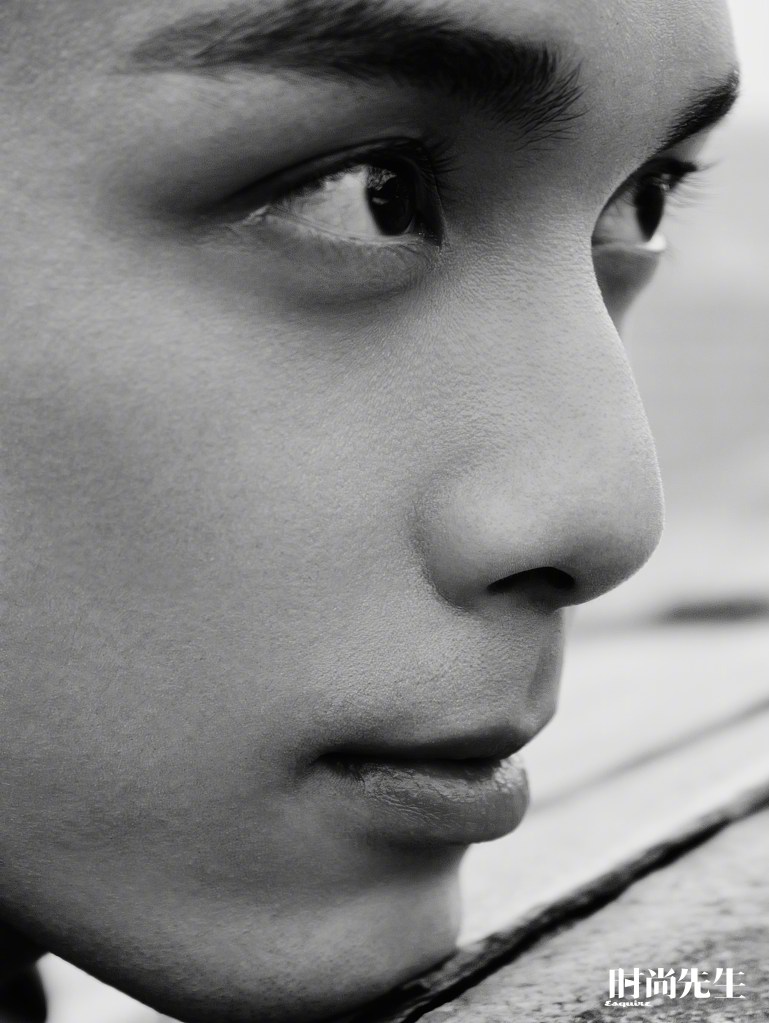
Eyes. The directors who have collaborated with Wu Lei often mention those eyes. Director Li Xue of «Nirvana in Fire» said in an interview that during the casting of Fei Liu, the initial selected actors did not have this kind of clean things that can be found in this kid’s eyes. If Wu Lei won the Most Promising Actor Award at the China TV Drama Awards for his character Fei Liu as a fifteen or sixteen-year-old child actor, then this consistent temperament he had for Dwelling by the West Lake» is even more precious.

Chen Jianbin plays the second male lead in «Dwelling by the West Lake». During Dong Yuhui’s livestream, he talked about his impression of Wu Lei, “The first time I had a scene with Wu Lei was when I stood in front of the tea house and he was coming down the mountains by bike. I thought he was so full of energy, very healthy. When he is in front of me, I glance at him and I feel like I can catch his heart just by looking through his eyes. He really has a pure pair of eyes.” He debuted as a child star, with nearly 20 years of acting experience, Chen Jianbin says of Wu Lei that he is “a young actor with an old soul”. “After all, he’s been wandering in this complex world for so long, and he spent his childhood in various filming sets. Actually, rude behaviors are hard to avoid but he has really good mechanisms to eliminate these and maintain a good mindset. There’s this force in him that makes me really moved.”

Eliminating distracting thoughts requires full focus on acting itself. Director Chen Changfen of «Nothing but You» once shared, that Wu Lei doesn’t sit on the standard lounge chair, but prefers to sit on a small stool he brought himself. During a summer of over 40°C in Shenzhen, the character that Wu Lei portrays, Song Sanchuan needed to play tennis non-stop. After only playing for 10 minutes, Wu Lei’s makeup started melting off and he simply decided to stay barefaced. He can accept it. Not only does he hope to be as close as his character in terms of tennis skills, but also to demonstrate the sincerity and the health of an athlete.

Few people will doubt Wu Lei’s self-discipline and hard work. He may be the young man who knows how to ride horses the most. You look at him riding a horse across Ulan Butong snowfields under minus 28°C and you have to admire the power he has in pulling the reins in one hand, and his astonishing vision, he can see horses and roe deers when they are only a black dot in the distance. In «My Country, My Parents», «Chengfeng» part, Wu Jing who has collaborated with Wu Lei, described him as «an actor who complies with everything unconditionally», “can you start practicing horse riding one month in advance ? Yes. Can you be shirtless? Yes. Can you tan ? Yes. Can you shave your head ? Yes.” When filming a fight scene with guns, a bullet exploded and Wu Lei’s face got injured. He persisted until the end of shooting to seek medical attention.

Besides being dedicated to his work, Wu Lei is also very intelligent. He debuted at 6 years old, and he obtained Nezha’s role on his own. The assistant director of «The Legend of the Hero» went to his school to cast actors, Wu Lei did not think twice and chased after him. He shouted, “Brother, I’m also an actor. Take a few shots of me too.” When he was still a child, he said in a program,

What is a smart actor ? Having a clear knowledge of how to treat a project may be one of the expressions of intelligence. Although Wu Lei says his criterion of judgment for a script is “I like it so it’s good”, it’s a broad criterion. But a busybody still can find out some clues of “what they like”. When he accepted «Nothing but You», he said the script has a very advanced perception of love and he cannot miss it. It’s proven by facts, this drama is one of the few urban romance dramas that “does not contain industrial saccharin” at all. Looking at each other on the same level, exploring a relationship that they mutually work on, this drama got a Douban rating of 8.2.

He accepted «Love like the Galaxy» because of its complexity.

Later, when he talked about his understanding of the young general Ling Buyi, he would always mention this seemingly unimportant line, “I never eat after lunch”, after noon I don’t eat anymore, if I eat too much, I feel sleepy and I lose my fighting spirit.

This is the key to his character. When he can’t understand a character, he will study the character’s behavior, and will have strict demands for himself. During the filming of «Love like the Galaxy», he would work out no matter how late it was, forcing his body to remain in a tough state. He forced himself to understand the character’s spirit of restlessly seeking for revenge. In the script, Ling Buyi’s line would always start with ‘I, Ling…’, Wu Lei changed every ‘I, Ling’ to ‘I… ‘. His understanding is, considering his emotional journey, Ling Buyi would never call himself ‘I, Ling’.

Others would consider «Love like the Galaxy» as a shifting point. Not only because this is the character that went out of the circle after his character Fei Liu from «Nirvana in Fire», but it is also because in this drama, Wu Lei has once again transformed his image on screen. Ling Buyi’s character is so suspicious, ruthless and dark which is far from Wu Lei’s true nature. To some extent, Wu Lei completed his transformation from a little boy, a little brother to a man, a boyfriend through Ling Buyi.

Regarding acting, Wu Lei may not have ambition written on his face but he has enough patience. “An actor definitely has stages but the limitations of this stage should be determined by yourself, there is no standard answer to what I should film. A lot of things should come naturally, they cannot be forced. I used to think that I can only see such a great script like «Dwelling by the West Lake», such a great story, such a great director only after 35 years old. Who could have thought that I would meet it less than two years after liking «Dwelling in the Fuchun Mountains» so much ?” He always thinks that the road is still long. In the early stage of his career, he was lucky enough to be appreciated and favored by the audience, he said it gave him reassurance and he felt tolerated. It made him feel like he has plenty of time to meet each of his character.

20 years after debuting, “veteran actor” Wu Lei no longer likes sharing his thoughts on acting with the outside world, “It’s not that I don’t want to tell or that there are some untold mysteries but it’s because acting has become more and more private, I feel like I should think about it alone. Many things taste different when told.”

In «Dwelling by the West Lake», He Mulian is a young man who struggles to find a job after graduating with an unclear future. This is a difficulty that many young people will inevitably face one day. Wu Lei started working very early, and it seems his future is not a problem for him. But he states, “My worries are probably similar to Mulian’s. I want to keep on acting, but sometimes actors become jobless after finishing filming. When I’m on break, I still want to film, so I’m similar to Mulian who needs to find a job.”

The outside world’s expectations are one thing, Wu Lei says, what he wants to do most is to prove himself to himself. At age 18, he played the role of young warrior Yang Ping in Zhang Yimou’s movie «Shadow» and shortly after, he was admitted in Beijing Film Academy with the highest score of the country. After reaching legal age, he took a step after another and broke through his image, creating well-loved characters such as Ashile Sun, Zheng Yuxing, Ling Buyi, Song Sanchuan, Lin Yiyang and He Mulian. Wu Lei is overall satisfied with his works in recent years, “Anyway, I have satisfied my expectations.” Doubts appear more often during the daily breaks between filming, worrying and thinking of the characters and details. There are times when he wanted to stop working so hard, but after calming down, after finding reason, he still felt, or rather he increasingly felt, being an actor is the happiest profession in the world.

In the past two years, the happiest moment in Wu Lei’s life was probably filming «Ride Now». He likes riding bikes, from Quanzhou to Xiamen, cycling around Qingdao Lake with his friends or stepping alone on the long road around Sailimu Lake. Over the past three years, behind the more and more qualitative production of his videos, is Wu Lei’s wholehearted dedication. He is not only a cyclist, he is also a director, a planner. Executing it is really not an easy task. He always shoots videos when the filming team is changing location or after the wrapping of his work. For him, “being on the road” is also like resting. “I like riding bicycles, I am doing something that makes me happy and during that process, I also received some love, I feel so lucky.”

Lucky, Wu Lei repeatedly emphasized. He didn’t feel tired filming one project after another. In reality, actor Wu Lei has never wanted to take a break,

Wu Lei is good at learning through his roles. He learned from Song Sanchuan what an outstanding boy can look like : respecting women, the sense of responsibility, the courage of a man. He maintains a friendly teacher student relationship with seniors of the industry. In the filming team of «Dwelling by the West Lake», he and «Sister Qin» both got baptized by the script like battle companions and from Chen Jianbin, he learned a more open way to regard performance.

At the same time, Wu Lei is also good at finding fun in life. Gaming, eating takeout all can make him happy. What if we use three words to describe ourselves?

He says he would answer : My gaming skills are extremely high, I know how to order takeout, I can easily remember how long each food needs to be boiled in a lamb hotpot.

After the interview, he started playing with a children’s skateboard, bent over and walked back and forth in the hallway with excitement. He just subtly switched from serious to relaxed, from stable and mature to lively like a young a man. It reminds people of Chen Jianbin’s description, Wu Lei is “a young actor with an old soul.”

Original article: Esquire WeChat

240409 [Interview] Wu Lei x Dwelling By The West Lake x Bazaar Interview

How did you first get in touch with Gu Xiaogang?

“I already really liked ‘Dwelling in the Fuchun Mountains’ directed by him. Then, he sent the script to me and I was immediately attracted after reading it. Of course, I hesitated for a long time because I was afraid of not doing a good job. I was filming another project at that time and I was worried about not being able to adjust my mindset. However, the director and the producers encouraged me a lot and I could eventually be confident enough. Later, the filming was also a bliss. We talked a lot in the early part of the process, about DBTWL but also about the movies that we enjoyed and disliked, about our hobbies, in short it was to enhance our mutual understanding. Don’t be fooled by Gu Xiaogang’s artistic and literary style, he used to be a teenager who enjoyed esports (laughs).”

In addition to DBTWL, you have also recently played in ‘All Ears’, a movie with artistic and literary attributes, can we discuss your recent approach to choosing projects?

“Of course I want to try different kind of projects but I don’t choose a certain theme on purpose, I just filter out the opportunities I have. In general, I still prioritize the character, I will still choose roles that attract me. I will also adjust and change my performance style according to the different themes.”

How were you feeling most of the time during the filming?

“I think this time, my performance relied on improvisation a lot. Director gave me a lot of freedom and he often gave us fresh stimulations and instructions. Everyone had to give out a new reaction based on new situations. We often filmed for a long time, the longest being two hours and we only had two or three lines for that scene. Director would tell me ‘Talk when you want to talk again’. I needed to slowly feel the space, the characters and the performance of that movie and quietly wait for the right moment to take action.”

You have many scenes located in the countryside when you spent most of your life in the city, how did you immerse yourself in your character ?

He Mulian is a complex character, although he comes from the countryside, his rural attributes have almost completely faded. After all, he attended university for four years in the city so he got used to the urban atmosphere. He looks like a “son of nature” and by that, I don’t mean the kind of character in a superhero movie with special abilities, but I’m saying he can become one with nature, he’s very intimate with trees, with bugs and wild animals. He’s not the spokesperson of nature but he is the son of nature. He’s like a plant in the forest, a big tree, or a lotus, he has a non-confrontational temperament. That’s why I went to botanical gardens prior to the filming and I started to grow plants myself, wishing I could get a deeper connection with them.”

What kind of plants did you grow?

For example, three-seven leaves (ginseng), amaryllis, in short all kinds of flowers and plants. I think plants also have preferences, they also think and seek for the direction of light, for places where nutrients are and they have things they don’t like. You need to understand the language of plants. During the filming, we also shot many dialogues with plants. It can sound a bit unreliable but I really think plants have their own intelligence.

Although Mulian is emotionally stable most of the time, there are moments where he almost falls into madness. How did you approach that state of mind?

Because we were constantly filming pyramid schemes scenes, I was also constantly stimulated. The despair and disbelief Mulian felt at the end actually coincided with my own feelings. I remember when he was turning insane, he almost fell into chaos, chopping down a tree restlessly. Chopping that tree was not only about killing his father, but he was also killing his conscience, justice and his innocence. That feeling of being unable to distinguish passive and active is also a feeling I have experienced. But fortunately, he eventually woke up in time and returned to the right track of life.

You also create some shots yourself, such as vlogs like “Ride Now”. You are also collaborating with more and more directors so how do you approach such a thing as filming now?

Filming vlogs is actually based on my own preferences, I will do it according to how interesting, how amusing it is. It is a slow journey that is different to daily life. Choosing the location beforehand, planning it, filming it on the road, collecting materials for post-production, coloring and editing it, releasing it and reading fans and audience’s reactions are all part of the journey. However, I have always been resisting this identity of being the “Director of Ride Now”. It’s not that I can’t accept it, it just makes me nervous. Because I think every field has its professionals, I’m not a director because I feel like I am one. But it’s true that I can’t find a better description, maybe I just want to be the director of my own life.”

Translation credit to @eowuli