
Wu Lei: A young and steady man
At the end of the year, we start to summarize the gains and losses of the year. Vogue Me’s December issue launched the topic ME’s 2019 emotional keywords. We have summarized the top ten emotions that appeared most frequently among young people this year. Today we will reveal the first of them, the annual emotional keyword for cover character Wu Lei – stability.

The intensity of emotions seems to be assumed to be inversely proportional to age. When it comes to 20 years old, the ups and downs of emotions are probably always intense, good and bad, like a stone that breaks the calm surface of a lake. The bigger the waves it stirs up, the more energetic it is. I met Wu Lei, who is about to turn 20, with my predictions about what a 20-year-old’s emotions should be like. The key words did not fall within the expected range, but it was satisfying. The key words did not fall within the expected range, but it was satisfying.
Age does not apply to the above assumptions, because Wu Lei’s stability is consistent throughout.
Stable Career
Acting as an Actor is My Destiny
“Acting may be my destiny. If I weren’t an actor, I really don’t know what I would do.”
Wu Lei starred in his first commercial at the age of 3, made his screen debut at the age of 5, and has been in the industry for 17 years. He is a boy that everyone has watched grow up. This kind of intimacy that is naturally built up over time not only brings extra love from the audience, but also attention and expectations. There are many children who grow up in the halo, but not everyone can clearly distinguish between true and pure love and giving back to the outside world’s excessive expectations. Is being a good actor really motivated by pure love?
In 2014, 15-year-old Wu Lei could answer this question. If when he was a child, the praises from the crew were more or less “a cute and smart kid”, then starting from the filming of The Return of the Condor Heroes that year, Wu Lei truly felt the difference between “being recognized” and “being liked”.

“Because I debuted relatively early, everyone in the crew calls me Wu laoshi. Although I know that 80% of them are joking, the feeling of being recognized by everyone is very gratifying.” When the efforts I put in as an actor are sincerely rewarded by everyone, from the encouragement from the director to other actors, the joy in their eyes and the sparks that collide in the cooperation, these things begin to truly stimulate the idea of ”becoming a good actor” and turn it into a belief.
In 2018, like any other high school student, after a year of getting up early and going to bed late to prepare for the college entrance examination, Wu Lei was admitted to the Beijing Film Academy and began his college life. It is hard not to wonder, for a kid who grew up on the set and in the crew, after more than a decade of acting experience, can the theory and practice on campus still excite him?
College student Wu Lei gave an affirmative answer. “In fact, the only difference between me and normal children is that I knew what I wanted to do from a young age. Most people start to do their favorite jobs and start a career after graduating from college. The difference between me and others is that I entered the industry I like early, nothing else is different. So I’m still excited about college life. Learning professional knowledge in school and learning how to enrich and improve myself are very helpful for the performance that I love.”

The staff who has been with Wu Lei said that the older he gets, the stronger his love for acting becomes, and the clearer he is about what he is doing and what he wants to do. He also thinks more unconsciously. He watches a wide range of movies and art works. Absorbing nutrition, broadening boundaries, and considering one’s original intention as an actor. In an era when original intention is widely discussed, the criteria for consideration have become uncertain.
As an actor, it is an ideal state to fully achieve self-satisfaction, director’s expectations, and audience’s feedback, but most of the time, the three are in conflict with each other. When you have achieved your own and the director’s expectations but are still not understood by the audience in an ideal way, should you explain?
Wu Lei spent a little longer thinking about this question than the others. If we have to choose one of these three as the standard to measure actor Wu Lei’s performance, it seems difficult to establish.

“If you feel that a work has met your expectations and the director also thinks it is good, but the audience’s feedback is not so satisfactory, I think that is my own problem. I used to have the urge to explain to the audience, but it is better to reflect on myself. In the final analysis, I must have done something wrong to cause this situation.” It can be seen that he was seriously looking for his feelings as a viewer in his memories, and then comparing them with his expression as an actor. The conclusion is that Wu Lei chose not to respond with the argument that “you just can’t understand my work.”
“If the audience can’t understand a work, then the work is meaningless. I don’t act to amuse myself.” This is probably my favorite answer when we talk about acting, an answer that may be misinterpreted, but it is powerful. Expression is the original intention of actor Wu Lei. He clearly knows that although there is no right or wrong in the form of expression, it is something that should be insisted on to find a suitable method within the scope of one’s ability.


Emotionally Stable
An emotionless formidable e-sports player
“Besides being an actor, how would you like others to introduce Wu Lei?” “As an e-sports player! Haha.”
Sure enough, no matter what era or form electronic games appear in, they have always firmly controlled the hearts of boys of all ages. I have seen too many male classmates who either howl in battle or kill with red eyes when playing games, so I can’t help but be curious, what does e-sports player Wu Lei look like? After a day of getting along with him, I confirmed that when Wu Lei plays games, if you don’t look closely, you probably don’t know he is playing games. He is so calm that it seems like the game is not fun.
“When I play video games, I’m very serious. I will analyze data, observe the enemy’s attack methods, reflect and review. Unlike others who play games for fun, I play games to win, and I’m very serious. It is actually very similar to acting.” Unlike the excitement of the virtual world in games that many boys are obsessed with, what attracts Wu Lei most about games is that “playing games well actually requires a lot of skills, teamwork, data analysis, etc. It is not a particularly easy thing.”

“Don’t get carried away, don’t show off, play it safe” is the missing option in the 20-year-old emotional prediction form, but it is truly reflected in Wu Lei’s emotional coping from childhood to adulthood. For Wu Lei, who grew up almost in front of the camera, pressure is an unavoidable theme. While the audience is rating his performance in front of the camera, the outside world is also curious about his life behind the camera. With the development of the Internet, there is no privacy now, let alone losing control, Wu Lei has never even subconsciously released negative emotions.
“I do feel that the attention from the outside world can be a pressure, which can be both good and bad. As an actor, of course I want to be noticed, but I’m used to it. People will ask you what the difference is between you in front of the camera and behind the camera, but the camera really exists in most of my lives. So the Wu Lei in the camera is the normal Wu Lei. “He doesn’t use games as an outlet to relieve stress, nor does he need to. Wu Lei’s stress relief system is all about competing with himself.
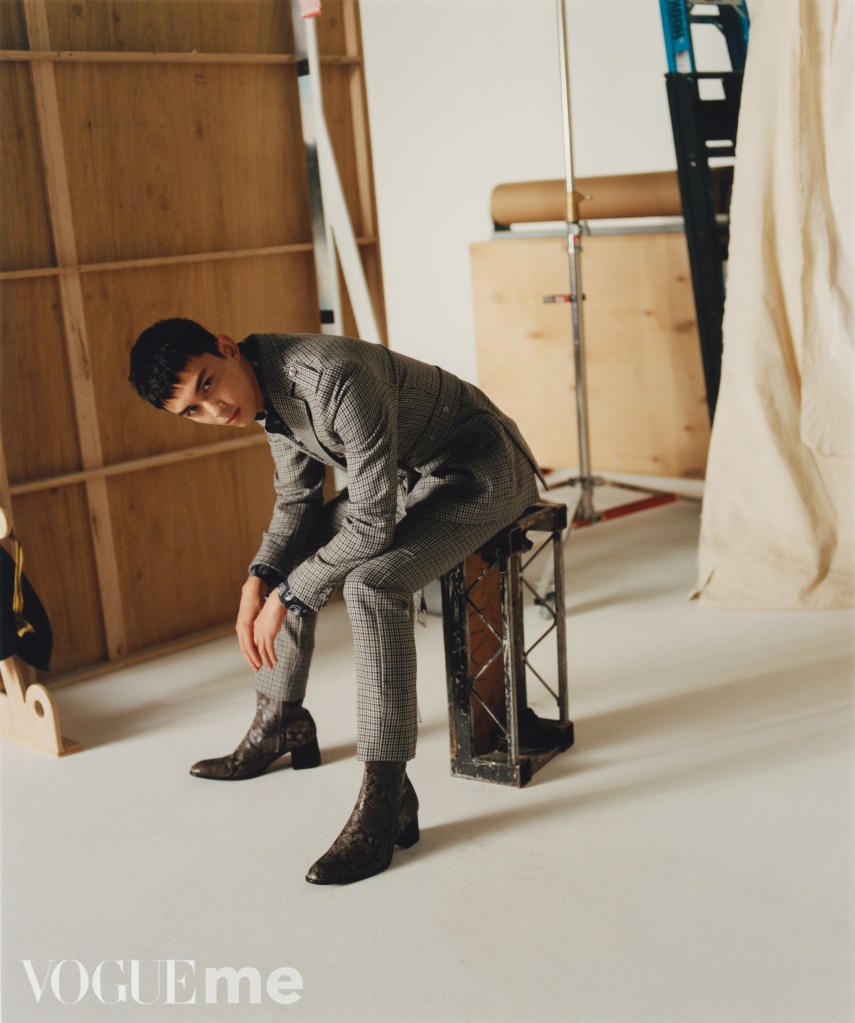
“Many times, pressure is self-imposed. The outside world will have an impact on us, but we still put pressure on ourselves. When acting in an important scene, the pressure is particularly great. There is no way to relieve it, it will be fine after the performance. Facing the pressure directly is the only solution.” In addition to solving his own pressure neatly and simply, not transferring the pressure to others is one of the things that people admire about Wu Lei during the filming process.
The day of the shoot was the first time Wu Lei met Céline. The time was short and the shoot was intensive, so the makeup and hair styling times were staggered to improve efficiency, so the two had no time to get familiar with each other in advance. It would be a lie to say that he wasn’t embarrassed at all. Fortunately, “shooting for magazines is different from acting. It’s the same as the NBA. Acting is like the playoffs and you have to be serious. Shooting for magazines is more like the All-Stars, just for fun.” Wu Lei’s kindness and friendliness made people feel that everything was not just politeness. He greeted people naturally and taught Céline simple Chinese. When the two of them started laughing at each other in front of the camera, it felt like a “click” between them.

“Besides being an actor, how do you want others to introduce Wu Lei?” The e-sports player gave a more serious answer: “It would be nice if people introduced Wu Lei as a pretty OK person.”
Steady
Zero-conflict energy release
During a break in filming, I asked Wu Lei’s mother: When was he the most rebellious since he was a child?
His mother thought about it seriously and gave me an unexpected answer: now. When I asked Wu Lei a similar question, he answered: the upcoming 20th birthday is not much different from the 19th birthday. Instead, “after my 18th birthday, I really felt that I had grown up.”
For Wu Lei, turning 18 not only means a grand birthday party, facing the fans’ love head-on and giving back seriously, but also means legal adulthood, a node where he begins to be completely responsible for his own words and deeds; it means starting a new college life, clarifying the direction of his performance and working hard; it also means that the time he will spend away from his hometown Shanghai will only get longer and longer, and the unfamiliar circles he needs to enter alone will be wider, and the thinking that comes with it will be more frequent. This also explains why his mother feels that Wu Lei’s rebellion has only just begun. Wu Lei is clever and straightforward, and his mother was always by his side when he was young, so he could more or less grasp and find the right balance. After turning 18 and starting college life, he inevitably had to take charge of everything himself.
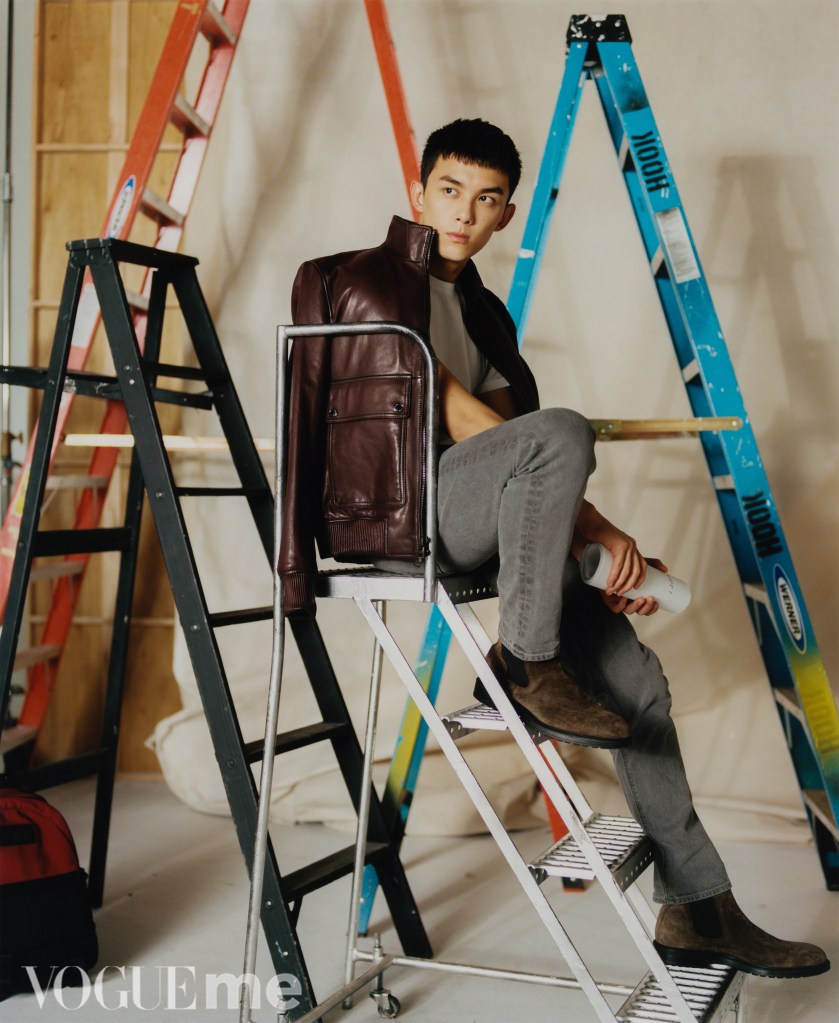
His mother’s worries are not unnecessary, but I can feel that when Wu Lei is gradually finding and releasing his own energy, he may be rebellious, but he has direction.
He understood the freedom at this moment as “eat whatever you want, shoot whatever you want, do what you like, and don’t force yourself to do things you don’t like.” It was an answer that came out of his mouth, just like answering what he had for lunch today. The content was simple and flawless, and there is no room for doubt.
Putting aside every aspect of Wu Lei as an actor on the screen, regarding Wu Lei himself, I recorded this day’s interaction with him with many questions and blank feelings. After watching all his video interviews and text conversations in the past five years, his cleverness, quick response, sunshine, and love of joking can be felt across the screen. But perhaps it is because the energy he conveys is too positive that it is hard not to be wary and guess that it is “too good to be true.”
In order to get rid of the interference of vigilance as much as possible, we did not record the conversation throughout the day. After chatting for a while, he went to change his clothes for the photo shoot, and I immediately typed down the content of the conversation.

I remember very clearly that there was a video shoot of Wu Lei, and the director gave intense instructions on how to perform emotionally. I was typing in the back room, and heard deafening roars from the studio across the wall, followed by the director’s “cut” and a satisfied “bravo”. The whole audience burst into applause, and that was the first time everyone was touched by his explosive power.
After the shoot, he went backstage to change his look and passed by the cubicle where I was typing. He crouched down and quietly approached me from behind, pretending to peek. When I turned around and he found that he had failed, he just laughed and went to change his clothes. Like a boy in middle school who failed to pull a prank, his childlikeness is oozing out. Not only the contrast between these two moments, but also many times, Wu Lei makes people feel that this boy is a tangible existence, not a perfect mannequin in a wax museum. When he needs to focus, he can do it in one take, and when he turns around, he is naughty like a 20-year-old boy who doesn’t need to hide. When the makeup artist held an umbrella for him in the glaring sunlight on the rooftop, he turned around and naturally looked into the other person’s eyes and said “thank you”. When there was a small incident in the middle of the shooting and a scene needed to be re-shot, he didn’t frown, but comforted the on-site dispatcher first, saying “I’m OK”.

There are many people on the set, and the team is not only new, but also mixed with English, French and Chinese. Sometimes when he was waiting for shooting instructions or scene setting, he was the only one in the brightest spot in the huge studio. His eyes were not wandering, his hands were not uneasy, he didn’t ask anyone to pass him water or play with his phone. He just stood naturally in the bright spotlight, and he was relaxed.
I can’t say if this is a habit of facing the attention from the outside world, but Wu Lei, who remains at ease under the blazing attention, will be particularly OK facing the countless uncertain possibilities in the future.
Source: VOGUEplus
 Wu Lei Galaxy